The road to a successful ERP transformation begins before project planning

Introduction
ERP transformation projects are complex for any organization. They require a strategic approach and careful planning. When things don’t go as expected, people often blame mistakes made during the project. But projects can also fail due to issues that could have been identified long before project planning even began.
This article describes how to identify these challenges in practice and how to use your findings as a concrete foundation for planning your transformation process.
Establishing Organizational Self-Insight
There can be many reasons—both external and internal—for needing to make major changes to the ERP platform. For example, we often see vendors like Microsoft and SAP discontinue maintenance of their older systems, forcing customers into a major transformation to solutions such as Dynamics BC or SAP S/4HANA. On the internal side, we often see requirements for ERP support of new strategic decisions and the need to further streamline ERP-supported business processes by using new functionality driven by artificial intelligence.
As a result, the company decides to carry out an ERP project. Typically, one starts by defining the objectives for the new solution, followed by requirement specifications/user stories related to business process support. After this, a system and partner selection is made, along with a decision on the project type.
What happens far less often, however, is that the company takes a step back before establishing objectives, to ask itself: How much ERP change can we realistically absorb in the short, medium, and long term? Organizations often feel pressed for time and eager to get started.
The recommendation, however, is that companies allocate time to develop the self-insight needed to determine their organizational readiness for an ERP transformation.
If you begin without this insight, you may generate ambitious ideas that you cannot support internally. Once you have communicated your ambitions internally and engaged a delivery partner, it becomes difficult to adjust them—both for change-management reasons and contractual ones. If you try to buy external help, you also risk handing over tasks to the delivery partner that should have contributed to internal anchoring.
There are various ways to carry out this clarifying process. One approach could be to structure the review under the following headings:
Organization and People
- The company’s strategic objectives, organizational structure, and culture
- Stakeholders’ justification for the desired change
- The resource situation—both qualitative and quantitative
Business Processes
- Maturity
- External requirements for changes
- Internal needs for changes
IT Environment
- Existing constraints and dependencies
- Expected functional scope in relation to the current system portfolio
- Master data maturity
Project Execution
- Definition of methodological requirements and expectations
- Expectations regarding roles and responsibilities

It is furthermore recommended that, during the planning phase, you formulate concrete discussion topics under each main heading that are relevant to the company’s specific situation (see the example in the graphic below).
When examining each topic, it is important to compare the findings from each individual discussion area with those from the others. This makes it possible to assess how the different findings interact.
For example, it is not necessarily critical if the organization is assessed as moderately ready for change. But if the organization also expects major process changes, the combination of these two findings will create a very different need for business involvement and change management—possibly requiring more time than initially anticipated. Another scenario could be that IT expresses a strong desire for cloud adoption, while compliance requirements pull in the opposite direction.
There can be many cross-implications. It may be beneficial to create a spreadsheet model where you list your discussion topics in a matrix that highlights which combinations may be relevant to analyze. There are usually more than one might expect.
The graphic below illustrates an example of discussion topics and expectations for where cross-implications may arise. The model should be adapted to the company’s specific context.
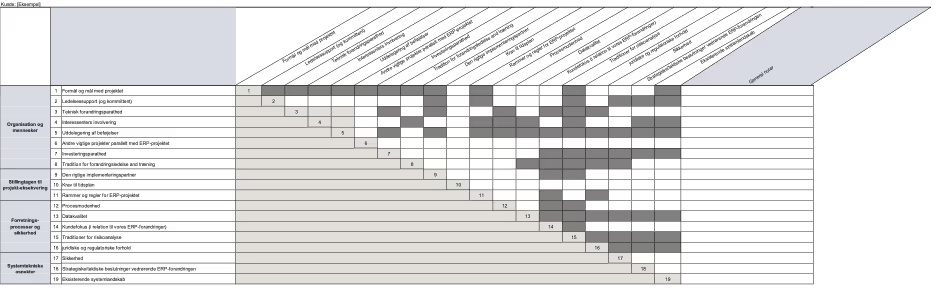
Assessment of Transformation Readiness and Roadmap Alternatives
Once organizational self-insight is in place, you have come a long way — but you still have not established a foundation for determining what the company can and will absorb in terms of changes and tasks related to an ERP transformation.
The next step, therefore, is to identify the company’s short- and long-term aspirations for the transformation, and, in that connection, to identify necessary pre-projects. For example, if the organization wishes to include additional business processes in a unified solution, there may be decisions and follow-on tasks related to establishing business process ownership and/or data harmonization before the actual ERP project tender process can begin. Acquisitions, divestments, or intentions to reorganize can also lead to process changes that must be accounted for in the project.
In general, you will find that the combination analysis described above reveals a number of concrete dependencies between the project’s scope, costs, resource needs, and expectations for the duration of the project — dependencies that would not have been visible without this exercise.
Once you have a clear overview, you are ready to set the corner flags for your long-term goals and prepare a roadmap that includes both organizational and/or technical pre-projects, as well as the sequence of ERP-related tasks.
The goal is not to create a weekly plan three years into the future. Rather, the goal is to keep the organization aligned on the planned sequence of activities and on the assumptions behind the transformation.
The roadmap can also serve as an internal communication tool. It will describe the future framework for the ERP solution landscape, indicate the expected timing of actual value creation, and estimate when resource demand will peak — especially in terms of personnel.
This provides the foundation for establishing the internal agreements or commitments that are often necessary to carry out a well-anchored ERP project.
Uncovering organizational ERP transformation readiness, as described above, may sound extensive, but the task can often be completed within a few weeks, depending on how many decisions have already been made and whether these decisions still appear realistic once the broader assessment has been carried out.
It is also worth noting that the documentation produced through this process provides a strong starting point for any subsequent tender process.
Conclusion
Organizational self-insight — and thus the assessment of a company’s ERP transformation readiness — is the foundation of a realistic ERP transformation roadmap from which concrete pre-projects and projects can be launched. By dedicating time and applying a structured approach to the preparation phase, organizations can identify potential challenges early, enabling them to make informed decisions and minimize risks. Investing in this phase can be crucial to ensuring that ERP projects are not only successful but also deliver long-term value.